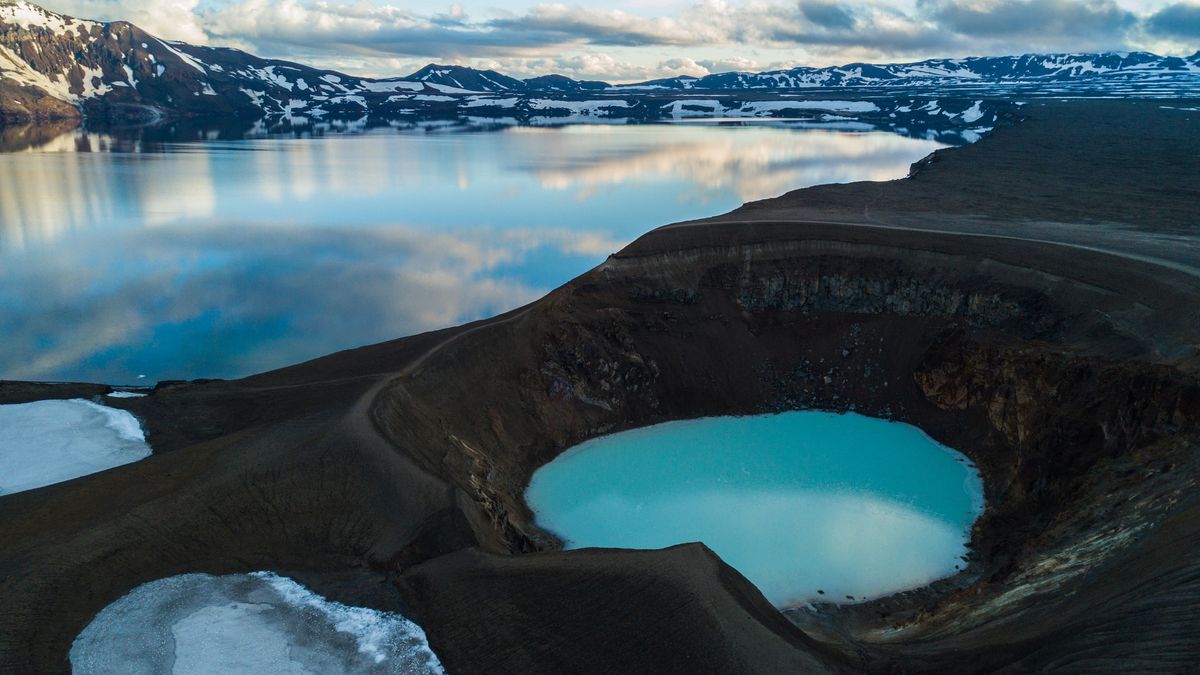
According to a new theory proposed by an international team of geophysicists and geologists, Iceland was the last of a nearly Texas-sized continent (called Iceland) that sank beneath the North Atlantic about 10 million years ago. It may be an exposed debris.
The theory goes against long-standing ideas about the formation of Iceland and the North Atlantic, but researchers say the theory explains both the geological features of the ocean floor and why. Earth The crust beneath Iceland is much thicker than it should be. An outside expert unrelated to the study told Live Science that he was skeptical of Iceland’s existence based on the evidence collected so far.
Nevertheless, if geological studies prove the theory, the fundamental new idea of a sunken continent is under the seabed belonging to a country that can show that the continental crust extends to that extent under international law. It can affect the ownership of the fuel found.
“A region with continental material below, that is Greenland Iceland
The continent of “Iceland” may have spread between Greenland and Scandinavia until about 10 million years ago, but another now submerged area west of England and Ireland is “Greater Iceland”. It was forming a part. (Image credit: Gillian Foulger / Google Maps)
Lost continent
The North Atlantic region was once a completely dry land, Pangea
However, Foulger and her co-authors suggest another theory that as Pangea collapsed, seas began to form almost south and north of Iceland, but not west and east. .. Instead, geologists wrote that the western and eastern regions remained connected to what is now Greenland and Scandinavia.
“People have this very simplified idea. Structural plate It’s like a dinner plate. Just split into two and separate. But it’s like pizza or artwork made from different materials. There is a difference here because there is fabric and there is ceramic. Parts have various strengths. “
According to a new theory, Pangea did not divide cleanly, leaving Iceland’s lost continent as uninterrupted dry land over 200 miles (300 km) wide, on the waves until about 10 million years ago. I stayed. Said. Eventually, the eastern and western ends of Iceland also sank, leaving only Iceland, she said.
The theory is that the crustal rocks beneath modern Iceland are about 25 miles (40) thick, rather than the thickness of about 5 miles (8 km) that would be expected if Iceland were formed on a volcanic eruption. Explain why it is the thickness of km).
“When we consider the possibility that this thick crust is a continent, all of our data suddenly makes sense,” Foulger said. Said in a statement
continental shelf
Foulger and her colleagues estimated that Iceland once spread over more than 230,000 square miles (600,000 square kilometers) of dry land between Greenland and Scandinavia. This is a little smaller than Texas. (Today, Iceland has an area of about 40,000 square miles, or 103,000 square kilometers.)
They suggested that to the west of what is now Britain and Ireland, there are similar sized neighbors that make up “Greater Iceland.” But they said the area was also sinking under the waves.
Fossil evidence has shown that some plants that spread by dropping seeds are identical in both Greenland and Scandinavia. The discovery reinforces the idea that a wide strip of dry land once connected the two areas, the author said. However, geologists are unaware of evidence of lost continental animal fossils.
Geographer Philip Steinberg, director of the Durham University Border Research Center, said Iceland’s new theory could affect fossil fuel ownership under the seafloor. Under international law, a country can claim their fossil fuels if evidence proves that the resources are under the country’s continental shelf-it can extend hundreds of miles across the coast. A relatively shallow area on the seabed.
Steinberg, who was not involved in Icelandic research, spent a great deal of money on geological research that could allow countries around the world to claim exclusive mining rights under the continental shelf. Said that.
In a statement, Steinberg said, “Studies like Professor Folger, who are forced to rethink the relationship between the seafloor and the geology of the continent, determine which areas of the seafloor are their exclusive reserves. It can have widespread impact on the countries that are trying to do so. “
The concept of Iceland goes against the general theory of the formation of the North Atlantic region, and some prominent geologists and geophysicists are critical of this idea.
Ian Dalziel, a geologist at the University of Texas at Austin, Last month I won the Penrose Medal Regarding his work on ancient geography and past supercontinents, he said he found little justification for his proposal.
Unlike The sunken continent of Zealandia For example, geologists have established that the North Atlantic region did not have enough continental crust material to form Iceland because it consisted of a continental crust that sank away from Antarctica, Darjeel said. He told Live Science by email.
Geophysicist Carmen Gaina, director of the Center for Global Evolution and Dynamics in Oslo, and Alexander Minakov of the University of Oslo, said the proposal was a “bold claim” with some problems and the existence of Iceland. I told Live Science by email. It was unlikely.
For example, a magnetic survey of the seafloor in this area shows a “striped pattern”. This shows when a continuous layer of melted crust was laid on the ocean floor of the North Atlantic Ocean as the ocean floor of the Earth. magnetic field
But “their conceptual view is a good starting point for discussion and, more importantly, a good starting point for collecting more relevant data,” said Gaina and Minakov. A calibrated explosion carried out by a research vessel.
Originally published in Live Science.